Improvement
How to Manage Your Clock in Chess: Time Tips for Beginners
Learn how to pace yourself on the chess clock, press it correctly, and avoid time trouble with practical habits for beginners.
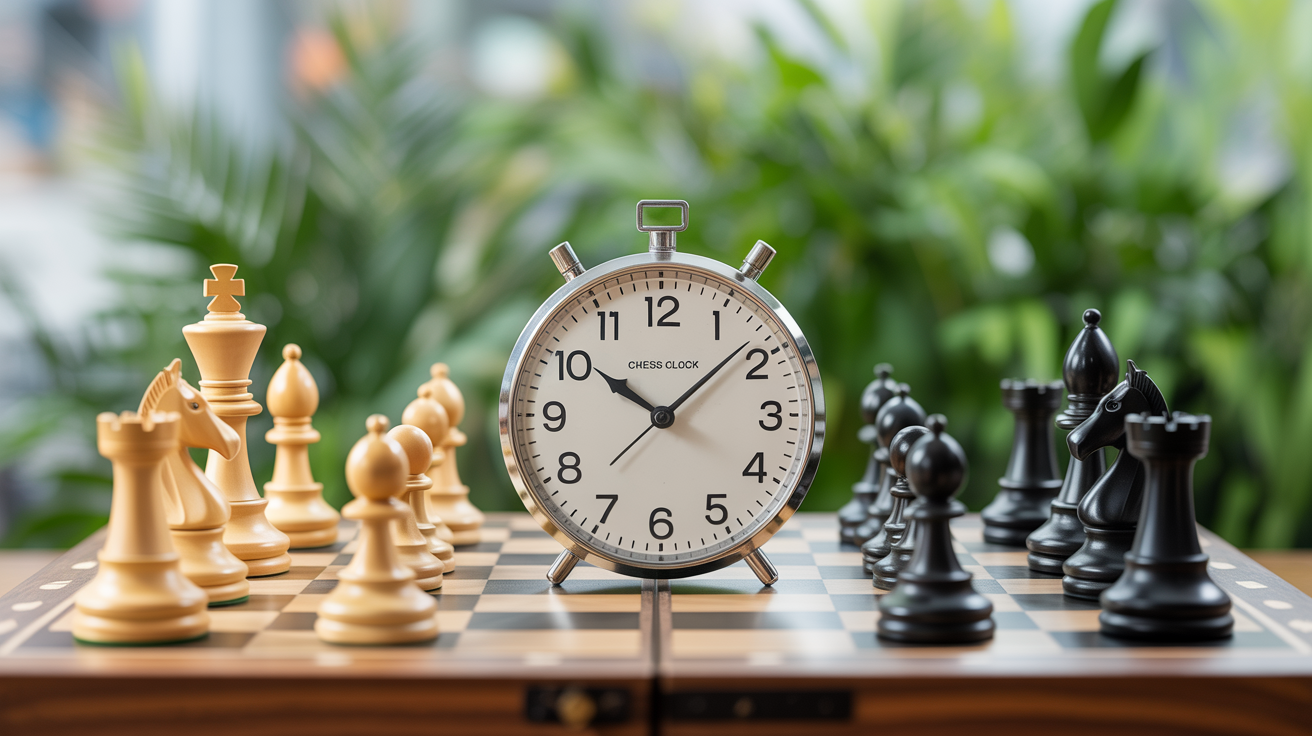
Losing on time when you had a winning position stings in a particular way. The game was yours, and then the clock took it. For most beginners, the clock feels like a secondary concern until it becomes an emergency, at which point panic sets in and the moves get worse fast.
Managing your clock is a learnable skill, and a few clear habits will go a long way. This guide covers how the clock works, how to pace yourself through a game, and what to do when you are getting low.
How Pressing the Clock Actually Works
Before anything else, get the mechanical habit right. After you make your move, you press the clock with the same hand you used to move the piece. This is the standard rule in over-the-board play, and pressing with your other hand can result in a penalty if an arbiter is watching.
Press the clock only after you have released the piece on its destination square. If you press before releasing, the move is not complete, and in a serious game that can cause a dispute. In casual or club play no one usually cares, but building the correct habit early saves headaches later.
For a full breakdown of how the different time formats work and what increment and delay mean, see Chess Time Controls Explained: Bullet, Blitz, Rapid, and Classical. Understanding the format you are playing is the foundation for managing your clock sensibly.
Pacing Yourself Across the Three Phases
A common beginner mistake is spending too long in the opening, reaching the middlegame with half the clock gone, and then rushing everything that follows.
A rough guideline that holds up across most time controls: use the first quarter of your time for the opening and early middlegame, the next half for the main middlegame where the real decisions are, and reserve the final quarter for the endgame and anything complicated that comes up late.
You do not need to track these fractions precisely. The practical version is: if you are a quarter through the game and you have already used half your time, you are in trouble and need to speed up now, not later.
Opening phase. Most opening moves should be quick. If you have studied even a few basic principles, moves like developing knights and bishops, castling, and controlling the center should take ten to thirty seconds. Save the thinking time for positions where you genuinely do not know what to do.
Middlegame. This is where most time gets spent, and rightly so. Tactics can appear out of nowhere, and a missed combination can lose a piece. Spend time here when the position is sharp or you are calculating a sequence. Positions that are quiet and maneuvering can move faster.
Endgame. Many beginners reach the endgame with almost nothing left on the clock because they burned it all earlier. If you manage to keep a couple of minutes going into an endgame, that is a real advantage. Endgames often require precise technique, and having time to think clearly makes a difference.
What to Do When You Are Low on Time
At some point you will find yourself with under a minute and still in the middlegame. Here is what helps.
First, stop second-guessing moves you have already identified as reasonable. The biggest time waster at low clock is re-examining a decision you have already made. If you saw a move, it is solid, and you are not seeing anything obviously wrong with it, play it.
Second, look for moves that create problems for your opponent rather than moves that require precise calculation from you. Checks, captures, and threats force your opponent to respond and keep the game active. A move that puts your opponent to work is often better than a quiet move that requires you to calculate five more moves ahead with thirty seconds left.
Third, keep pressing the clock the instant your piece lands. Every second you sit with your hand hovering is a second lost for no reason.
Finally, if you have increment on the clock (say, five seconds added after each move), those seconds add up. Play moves that keep the game going and trust the increment to sustain you.
Building Good Clock Habits in Practice
Time management is not something you improve just by reading about it. You improve it by playing games where the clock is present and paying attention to where your time actually goes.
After a game, take thirty seconds to ask yourself: did I use my time evenly? Did I spend too long on one move? Was I rushing at the end? That brief self-check, done consistently, teaches you more than any single tip.
Playing faster time controls occasionally (like 10+0 or 15+10) trains you to make decisions under pressure. The positions are the same; the clock just forces you to commit sooner. This is uncomfortable at first and genuinely useful over time.
For a broader framework on how to build these kinds of habits and improve systematically, see How to Get Better at Chess: A Beginner's Improvement Plan.
The Opening Phase Deserves Special Attention
The opening is where clock time most reliably leaks away for beginners, and the fix is straightforward: learn a small set of moves well enough that you do not need to think about them.
You do not need to memorize twenty moves of theory. Three to five moves of a solid opening that you understand and trust is enough to get through the early game quickly. When you know what you are doing in the opening, those first several moves cost almost no clock time at all.
If you do not have opening principles internalized yet, Chess Opening Principles: The 3 Rules Every Beginner Needs is a good place to start. Knowing those rules means you always have something sensible to play, and sensible moves played quickly are much better for your clock than perfect moves played slowly.
Frequently Asked Questions
How do I know if I'm spending too much time on a move?
A reasonable upper limit for a single move in most time controls is about 10% of your starting time. In a 30-minute game, spending more than three minutes on one move in the early middlegame is usually too much. If you find yourself going well past that, it is a sign you need to make a decision and move on rather than keep looking.
Is it okay to let my clock run low to find the best move?
Occasionally, yes. In a critical position where the game depends on finding the right sequence, using extra time makes sense. The problem is when it becomes a habit. Running your clock low regularly means you are chronically miscalculating how long decisions take, and you need to practice making faster choices.
What if my opponent is also low on time?
Play solid, legal moves and keep pressing your clock cleanly. Do not try to confuse your opponent by moving fast or slow in a tricky way. Just play decent moves and let both clocks do their work. Keeping a cool head when both players are low usually favors whoever has practiced handling time pressure more.
Does increment change how I should think about time?
Yes, meaningfully. With increment (for example, five or ten seconds added per move), you can play into a very low clock and survive as long as you keep moving. Without increment, once you are under thirty seconds, every move has to come immediately. Know which format you are playing before the game starts and adjust accordingly.
Can running out of time ever be the right call?
In practice play, yes. If you are in a lost position and spending time on every move hoping your opponent flags is a legitimate (if desperate) strategy. In over-the-board tournament play the same applies, though it is not a great habit to rely on. The better goal is to manage your clock well enough that you always have something left, no matter how the position turns out.