Rules & Basics
How the Chess Pieces Move: A Beginner's Guide to All Six
Learn exactly how each chess piece moves, from the powerful queen to the tricky knight, with clear rules and practical tips for beginners.
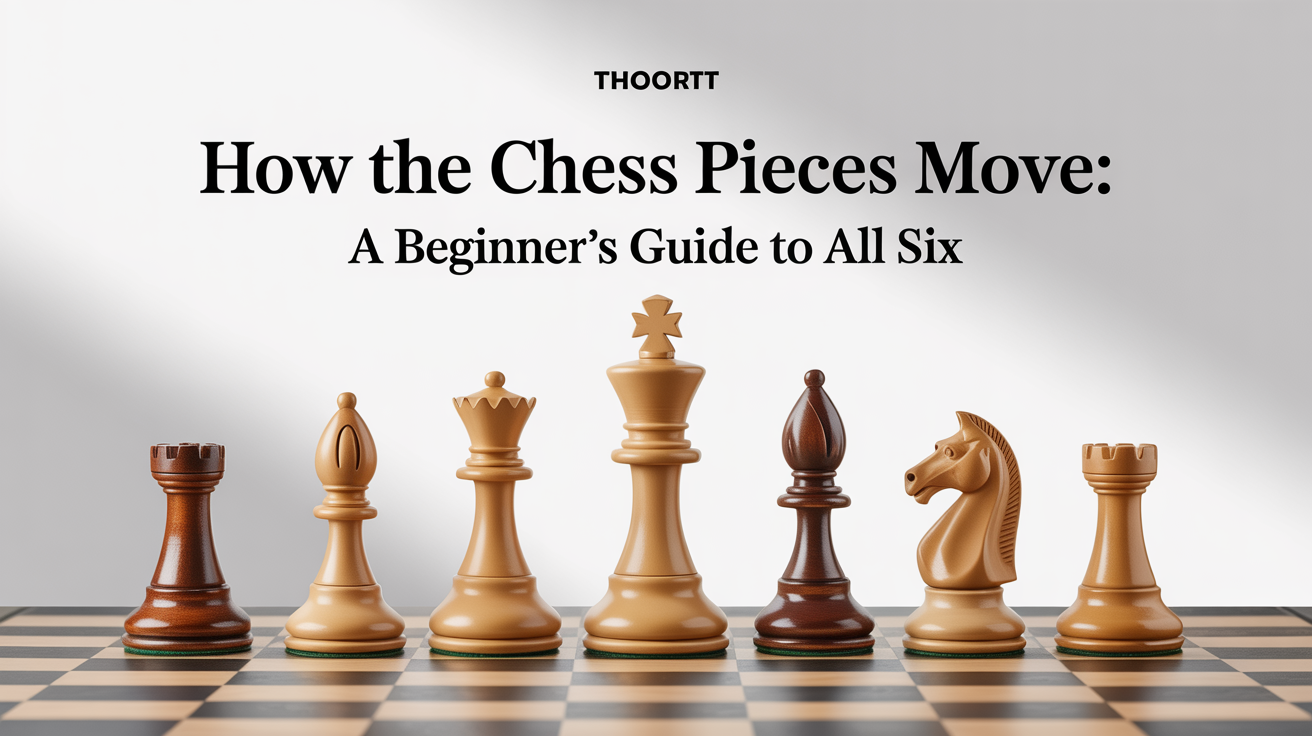
Each chess piece has its own movement rules, and once those click into place, the game starts making sense fast. There are six different pieces, and you only need a few minutes to learn what each one does. Below is a plain-English breakdown, piece by piece, with the most important details beginners tend to miss.
If you want the full picture of rules alongside this, see our guide on how to play chess for absolute beginners.
Piece Values at a Glance
Before diving in, here's a quick reference table that shows what each piece is worth in pawns. These aren't exact exchange rates, but they help you decide whether a trade is a good deal.
| Piece | Symbol | Approximate Value |
|---|---|---|
| Pawn | P | 1 point |
| Knight | N | 3 points |
| Bishop | B | 3 points |
| Rook | R | 5 points |
| Queen | Q | 9 points |
| King | K | Infinite (can't be traded) |
Now let's look at how each piece moves.
The King
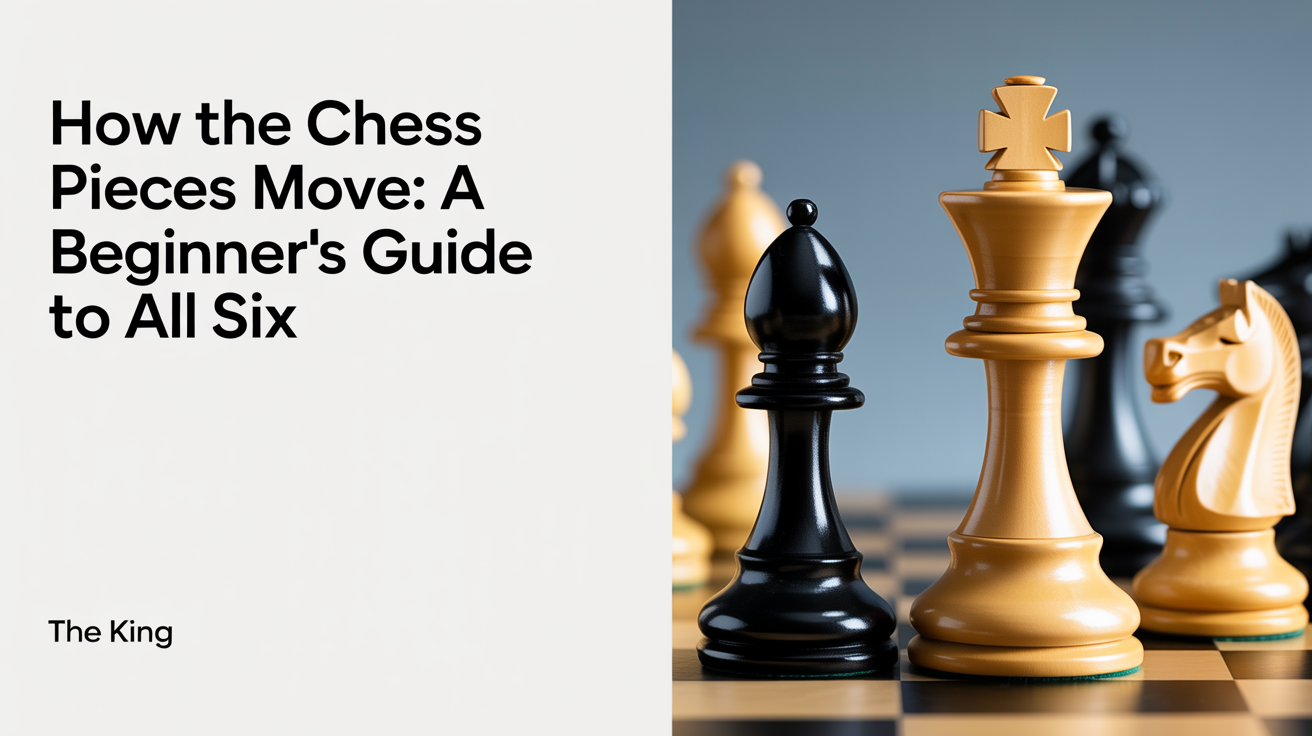
The king moves one square in any direction: forward, backward, sideways, or diagonally. That's all. One square at a time.
The king is the most important piece on the board. You don't win by capturing it, but if your king is about to be captured and you can't escape, that's checkmate, and the game ends. So protecting your king matters more than almost anything else.
The king has one special move called castling, where it moves two squares toward a rook and the rook jumps over to the other side. It's the only time two pieces move in a single turn, and it comes with a list of conditions. The full details are in our article on castling rules in chess.
One rule beginners often forget: the king cannot move into check. You can't walk your king into a square attacked by an opponent's piece, even if it looks like a good idea.
The Queen
The queen is the most powerful piece. She moves any number of squares in any direction: horizontally, vertically, or diagonally.
Think of the queen as a rook and a bishop combined. From the center of the board, she can potentially reach up to 27 different squares. That's why losing your queen early usually puts you in serious trouble.
A quick example: if your queen is on d1, she can slide all the way to d8 (vertical), to h1 (diagonal), or to a4 (horizontal), as long as no pieces are blocking the path. She can't jump over pieces.
Practical tip: don't bring your queen out in the very first moves of the game. Your opponent can chase her around with pawns and minor pieces, and you'll lose several tempos (turns) retreating while they develop their army.
The Rook
The rook moves horizontally or vertically, any number of squares. It cannot move diagonally.
Rooks are long-range pieces, but they need open files (columns with no pawns blocking them) to do their best work. Two rooks working together on the seventh rank (the row just in front of your opponent's back rank) can be devastating.
At the start of the game, both rooks are boxed in by other pieces. A big part of chess is simply getting your rooks into the game. That usually means advancing or trading pawns to open up files.
Rooks and castling: each rook is involved in one possible castling move, which links back to the king's special move mentioned above.
The Bishop
The bishop moves diagonally, any number of squares. Because of this, a bishop that starts on a light square stays on light squares for the entire game. Same for dark-square bishops.
This matters more than it might seem. If all your pawns are fixed on light squares, your light-squared bishop becomes blocked and nearly useless. That's what players mean when they say a bishop is "bad." The pawns and the bishop are fighting over the same color squares instead of working together.
Each player starts with two bishops: one on light squares, one on dark. The bishop pair (having both while your opponent has lost one) is a genuine advantage in open positions.
Comparison with the knight: bishops are worth roughly the same as knights (about 3 points), but they work very differently. Bishops love open positions with long diagonals; knights prefer closed positions where they can hop around without needing clear lines.
The Knight
The knight is the piece that confuses almost every beginner, and it's worth spending a few extra minutes on it.
The knight moves in an "L" shape: two squares in one direction, then one square perpendicular. It jumps over any pieces in between, which is something no other piece can do.
From the square e4, a knight can jump to these eight squares: d2, f2, c3, g3, c5, g5, d6, f6. Memorizing the L-shape pattern is easier than memorizing that list. Two up and one over. Two over and one up. All four rotations of that shape.
Why knights are tricky for beginners to face: because the knight jumps, you can't block it with another piece. The only ways to deal with a threatening knight are to move out of its attack, capture it, or put a piece on the square it wants to land on (called "blocking the landing square"). This catches a lot of new players off guard.
Knights are weakest at the edges of the board. On a corner square like a1, the knight only reaches two squares; in the center, it reaches eight. That's why you'll often hear the advice "knights on the rim are dim."
The Pawn
Pawns are the most restricted pieces but also the most plentiful. Each side starts with eight of them, and together they shape the character of the whole position.
How pawns move:
- Forward only, one square at a time.
- From their starting rank (rank 2 for White, rank 7 for Black), they can optionally advance two squares.
- Pawns capture diagonally forward, one square. This is different from how they move, which trips up beginners regularly.
So a pawn on e4 can move to e5 (if the square is empty), but it captures on d5 or f5. It cannot capture straight ahead.
Pawn promotion: if a pawn reaches the last rank (rank 8 for White, rank 1 for Black), it must be promoted to a queen, rook, bishop, or knight. Almost everyone promotes to a queen. This is one of the most game-changing rules in chess: a pawn that survives to the back rank becomes a queen.
En passant: there's one unusual pawn capture called en passant, where you can capture a pawn that just moved two squares as if it had only moved one. It's the most notorious rule in chess because it looks like it breaks the normal rules. We'll cover it in its own article.
Putting It All Together
Learning how chess pieces move is step one. Using them well takes longer, but you've got the foundation now. A few things to keep in mind as you start playing:
- All pieces block each other (except the knight). A rook can't slide through a friendly pawn; it has to go around or you have to move the pawn first.
- Captures work the same way as movement. A bishop moves diagonally, so it captures diagonally. A rook captures horizontally or vertically. The piece moves to the captured piece's square and the captured piece is removed.
- You can't capture your own pieces. You can only capture opponent pieces.
Before your first game, it also helps to have the board set up correctly from the start. See our article on how to set up a chess board the right way if you haven't done that yet.
FAQ
Which chess piece is the most powerful?
The queen is the most powerful piece. She combines the movement of a rook (horizontal and vertical) and a bishop (diagonal), letting her cover more squares than any other piece.
Can a knight jump over other pieces?
Yes. The knight is the only piece that can jump over pieces in its path. It still lands on a normal square at the end of its L-shaped move and can capture an opponent's piece on that landing square.
How does the pawn capture if it only moves forward?
Pawns move straight forward but capture one square diagonally forward. So a White pawn on e4 moves to e5 but captures on d5 or f5. The capture square and the movement square are different.
Can a king move more than one square?
No, except when castling (a special move involving the king and a rook). In all other situations, the king moves exactly one square in any direction.
What happens when a pawn reaches the other side of the board?
It promotes. The pawn is replaced by a queen, rook, bishop, or knight of the same color. In practice, nearly every promotion becomes a queen, since it's the most powerful piece.