Rules & Basics
How to Set Up a Chess Board the Right Way
Learn exactly where every chess piece goes before a game, including the queen-on-her-color rule and which direction the board faces.
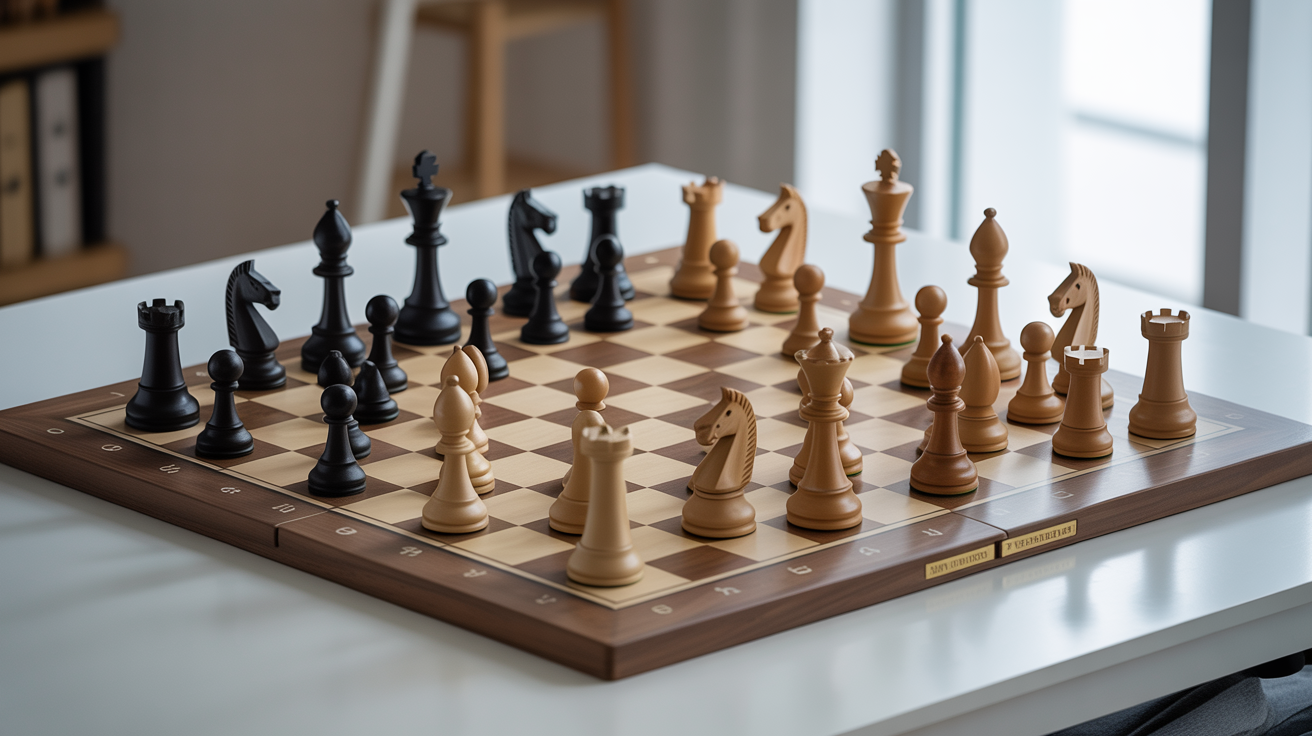
Getting the board wrong before move one is more common than you'd think. Even experienced players occasionally place the queen on the wrong square, and a misplaced king can quietly affect whether castling is legal later. Here's a clear walkthrough of chess board setup so you can get a game started confidently every time.
Orient the Board First
Before placing any pieces, check that the board is turned the right way. The square in the bottom-right corner, from each player's perspective, should be a light-colored square. A common way to remember it: light on right.
If you sit down and the bottom-right square is dark, rotate the board 90 degrees. This matters because every piece placement rule assumes correct orientation.
Place the Rooks in the Corners
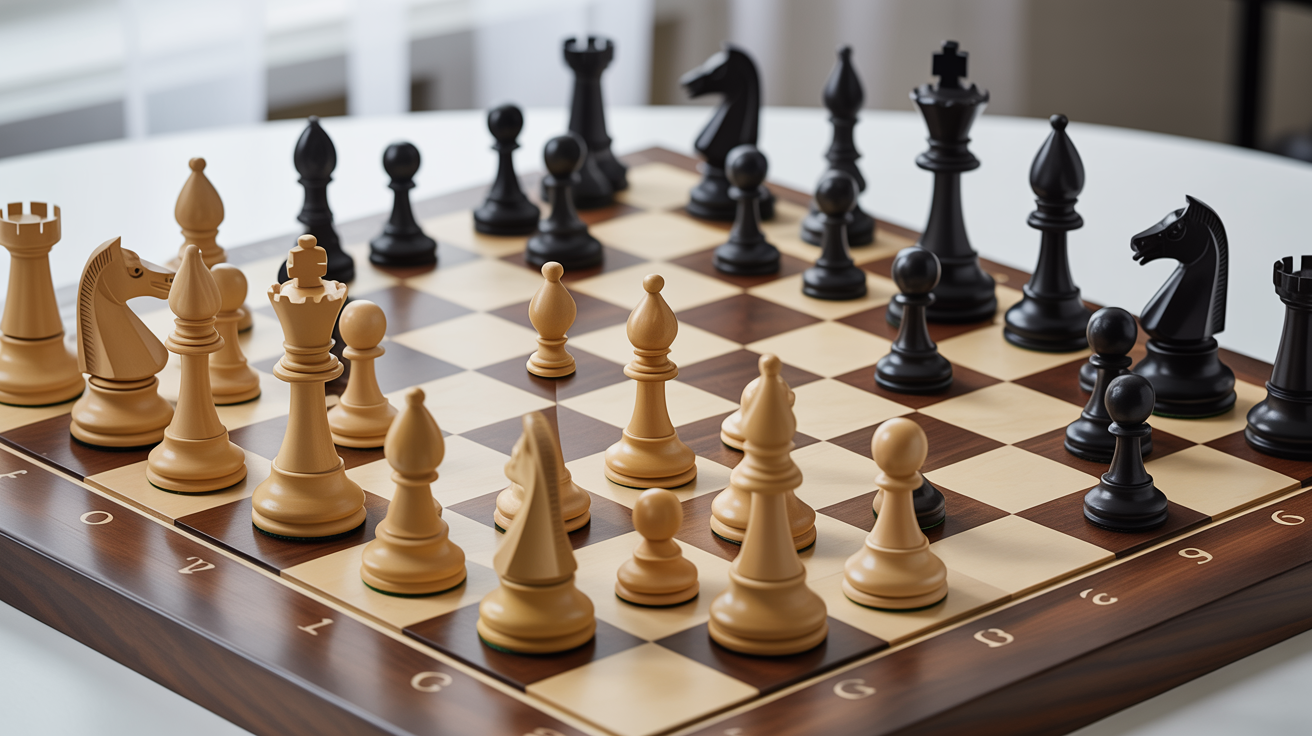
Put a rook on each corner square of your back rank (the row closest to you). For White, those squares are a1 and h1. For Black, a8 and h8. Rooks always go in the corners, which is easy to remember since they resemble towers and belong at the edges of the castle.
Knights Go Next to the Rooks
Place a knight on b1 and g1 for White, and b8 and g8 for Black. Each knight sits immediately inside a rook. Knights are the only pieces that can jump over others, so their starting position doesn't matter for the opening moves in a practical sense, but their placement is fixed.
Bishops Go Inside the Knights
Bishops fill the next squares inward: c1 and f1 for White, c8 and f8 for Black. You'll notice one bishop starts on a light square and one on a dark square. They stay on those colors for the entire game, since bishops only move diagonally.
The Queen Goes on Her Own Color
This is the step that trips people up most often. The queen goes on the remaining square that matches her color. White's queen goes on d1 (a light square). Black's queen goes on d8 (a dark square).
The phrase "queen on her own color" is a reliable reminder. If you look at your back rank and see the queen on a square that doesn't match her color, swap her with the king.
The King Takes the Last Square
With the queen placed, one square remains on the back rank: e1 for White and e8 for Black. The king goes there. As a check: the two kings and two queens should be lined up directly across from each other, king facing king and queen facing queen.
Pawns Fill the Second Rank
Finally, place all eight pawns on the second rank in front of your other pieces. For White, that's the entire a2-through-h2 row. For Black, it's a7 through h7. The pawns form a complete row and are the last pieces to be placed.
The Full Starting Position at a Glance
Here's a summary of where every piece belongs for White on the first rank (Black mirrors this on ranks 7 and 8):
| Square | Piece |
|---|---|
| a1 | Rook |
| b1 | Knight |
| c1 | Bishop |
| d1 | Queen |
| e1 | King |
| f1 | Bishop |
| g1 | Knight |
| h1 | Rook |
| a2–h2 | Pawns (all 8) |
Each player starts with 16 pieces: 1 king, 1 queen, 2 rooks, 2 bishops, 2 knights, and 8 pawns.
A Quick Setup Checklist
Before starting a game, run through this mentally:
- Light square in the bottom-right corner (light on right)
- Rooks in all four corners
- Knights beside the rooks
- Bishops beside the knights
- Queen on her own color (white queen on light, black queen on dark)
- King on the remaining center square
- Eight pawns across the second rank for each side
- Kings and queens facing each other straight across the board
Once the setup looks right, White always moves first. If you're not sure what each piece can do from its starting position, the guide to how chess pieces move walks through every piece in detail.
Why Correct Setup Matters
A wrong setup can create illegal positions that distort the whole game. For instance, if the king and queen are swapped, White's king starts on d1 and has already "moved" through e1 in spirit, but the real issue is that the castling squares differ. Under FIDE rules, castling requires that neither the king nor the rook has moved previously. If you start with the king on the wrong square and move it to the correct one "to fix" things, you've used up your castling rights.
It also affects the logic of early play. The center squares d4, d5, e4, and e5 are strategically important, and the complete rules guide for beginners explains why controlling that area from the start matters. Pieces that begin in the wrong spots change the geometry of those opening ideas.
FAQ
Which way does the chess board go?
The board should be oriented so that each player has a light-colored square in the bottom-right corner. This is sometimes called "light on right." If the corner square is dark, rotate the board.
Does it matter which color starts with which side?
By convention, the player with the lighter-colored pieces (called White, even if the actual colors differ) sits with their pieces on ranks 1 and 2. Black sits at ranks 7 and 8. White always makes the first move.
What if I forget where the queen goes?
Remember "queen on her own color." White's queen goes on the light square (d1), and Black's queen goes on the dark square (d8). If your queens don't match their square colors, they're in the wrong spots.
How can I tell the king from the queen at a glance?
The queen is usually the taller piece with a crown-like top (often with a small orb or circle). The king is typically similar in height but topped with a cross. In a standard Staunton set, the queen's crown has a pointed fleur-de-lis shape and the king's cross is more angular. If pieces look similar, the queen usually stands slightly taller.
What's the difference between the a1 square and the h1 square?
Files (columns) are lettered a through h from left to right from White's perspective. Ranks (rows) are numbered 1 through 8 from White's side. So a1 is White's bottom-left corner and h1 is White's bottom-right corner. Black's bottom-left corner (from their perspective) is h8, and their bottom-right is a8. Getting comfortable with this naming system is useful because it's the same notation used for recording moves.