Rules & Basics
How to Play Chess: The Complete Rules for Absolute Beginners
Learn how to play chess from scratch. This guide covers the board, every piece's moves, check, checkmate, and special rules — all in plain English.
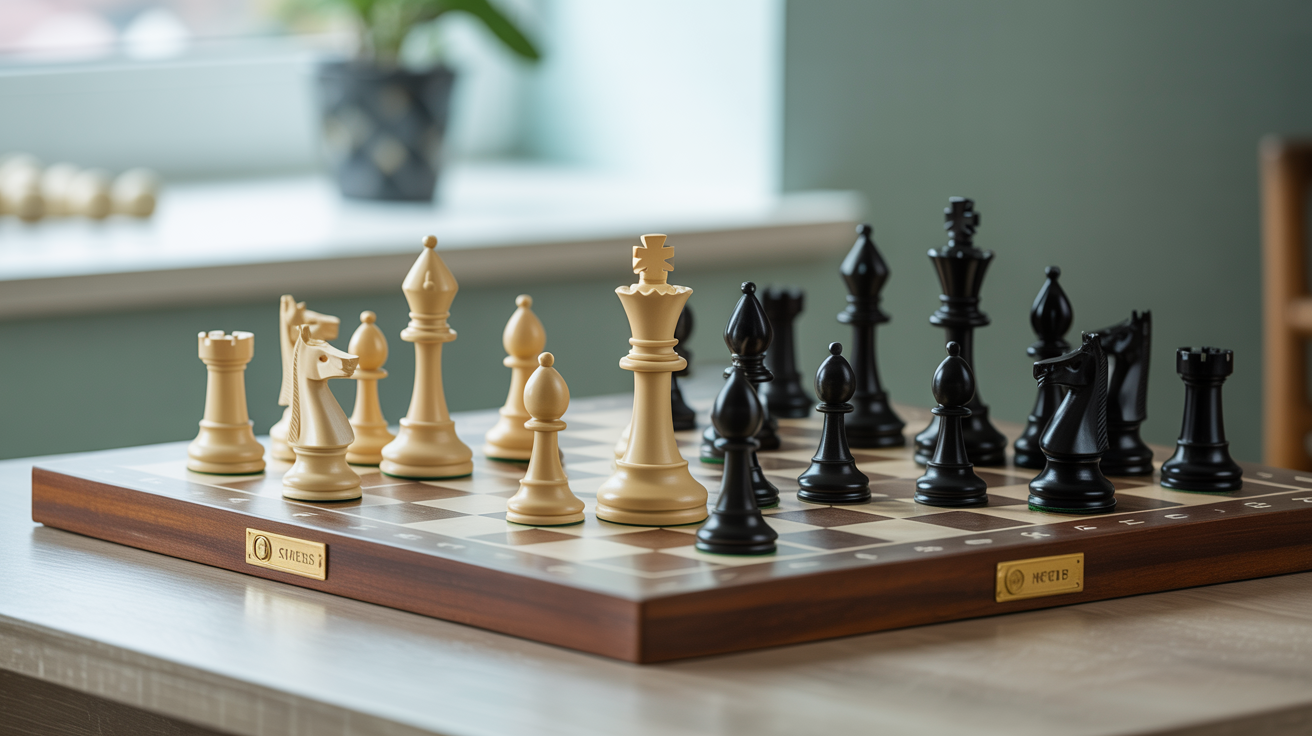
Chess has exactly 32 pieces, one board, and a ruleset you can learn in an afternoon. The goal is simple: trap your opponent's king so it has no escape. Everything else, the openings, the tactics, the endgames, builds on that one idea.
This guide covers the complete basic rules: how the board is set up, what each piece does, how turns work, and the special moves that trip up nearly every beginner.
The Board and the Coordinates
A chessboard has 64 squares arranged in an 8x8 grid, alternating light and dark. When you sit down to play, a light square should be in the bottom-right corner nearest you. (A quick check: "light on right.")
Squares are named by a letter and a number. Files (columns) run from a to h left to right from White's perspective. Ranks (rows) run from 1 to 8 bottom to top. So the square in White's bottom-right corner is h1, and the square directly across the board is h8.
You don't need to memorize every square name to start playing, but it helps when you want to learn chess notation or discuss moves with other players.
Setting Up the Pieces
Each player starts with 16 pieces: one king, one queen, two rooks, two bishops, two knights, and eight pawns.
For a full visual walkthrough, see how to set up a chess board the right way. The short version:
- Rooks go in the corners (a1, h1 for White).
- Knights go next to the rooks (b1, g1 for White).
- Bishops go next to the knights (c1, f1 for White).
- The queen goes on her own color: White queen on d1 (a light square), Black queen on d8 (a dark square). "Queen on her color" is the memory hook.
- The king takes the remaining central square (e1 for White, e8 for Black).
- Eight pawns fill the entire second rank for each side (rank 2 for White, rank 7 for Black).
How the Pieces Move
Each piece moves differently. Here's a quick reference:
| Piece | How It Moves | Point Value* |
|---|---|---|
| Pawn | One square forward; captures diagonally | 1 |
| Knight | L-shape: two squares one direction, one square perpendicular | 3 |
| Bishop | Any number of squares diagonally | 3 |
| Rook | Any number of squares horizontally or vertically | 5 |
| Queen | Any number of squares in any direction | 9 |
| King | One square in any direction | , |
*Point values are rough guides for comparing trades, not official rules.
Pawns have a few quirks worth noting:
- On their first move, a pawn can advance one or two squares forward.
- They capture diagonally (not straight ahead), which catches many beginners off guard.
- If a pawn reaches the opposite end of the board (rank 8 for White, rank 1 for Black), it promotes, you replace it with a queen, rook, bishop, or knight of your color. Promoting to a queen is almost always the right choice.
Knights are the only pieces that can jump over other pieces. An easy way to picture the move: two squares in a straight line, then one square to the side (or one square straight, then two to the side). The knight always lands on the opposite color square from where it started.
For a deeper look at what every piece can do, the article on how the chess pieces move walks through each one with examples.
How a Game Is Played
White always moves first. Players alternate turns, and on each turn you move exactly one piece (with one exception: castling, covered below).
You cannot skip your turn, and you cannot move into a square occupied by your own piece. You can move to a square occupied by an opponent's piece, that's called a capture. The captured piece is removed from the board.
Check
When your king is under attack by an opponent's piece, you're in check. You must get out of check immediately, you cannot make any other move. There are three ways out:
- Move the king to a safe square.
- Block the attack by placing one of your pieces in the path.
- Capture the attacking piece.
If none of those options work, the game is over: that's checkmate.
Checkmate
Checkmate ends the game. The checkmated player loses. There's no such thing as capturing the king, the game must end at checkmate before it ever gets that far.
Stalemate
Stalemate is not checkmate. It happens when the player whose turn it is has no legal move, but is not in check. The result is a draw. Stalemate catches beginners by surprise in endgames when one side has a huge material advantage but accidentally boxes the opponent's king in without checking it.
Draw by Other Means
Games can also end in a draw by:
- Agreement, both players decide to split the point.
- Threefold repetition, the same position appears three times (not necessarily consecutive moves).
- The 50-move rule, 50 consecutive moves without a capture or pawn move; either player can claim the draw.
- Insufficient material, neither side has enough pieces to force checkmate (for example, king vs. king and bishop).
The Special Moves
Castling
Castling is the one move where you move two pieces at once: the king and a rook. To castle kingside, the king slides two squares toward the h-file rook (e1 to g1 for White), and the rook jumps to the other side of the king (h1 to f1). To castle queenside, the king moves two squares toward the a-file rook (e1 to c1), and the rook lands on d1.
Castling is legal only when all of these conditions are met:
- Neither the king nor the rook involved has moved before in the game.
- There are no pieces between the king and the rook.
- The king is not currently in check.
- The king does not pass through a square that is under attack.
- The king does not land on a square that is under attack.
Full details and examples are in the castling rules guide.
En Passant
En passant (French for "in passing") is a special pawn capture that confuses most beginners when they first see it.
When a pawn advances two squares from its starting position and lands beside an opponent's pawn, the opponent may capture it as if it had only moved one square. This capture can only be made on the very next move, wait one turn and the opportunity is gone.
Example: White plays 1.e2-e4, and there is a Black pawn on d4. Black can respond with ...dxe3, capturing the White pawn that just advanced to e4, with the Black pawn landing on e3. The White pawn on e4 is removed.
A Quick Look at How Games Actually Go
A typical beginner game starts with both sides moving pawns toward the center, developing knights and bishops to useful squares, and castling to protect the king. A sample opening might look like:
1.e4 e5 2.Nf3 Nc6 3.Bc4
White occupies the center with the e-pawn (1.e4), Black mirrors with 1...e5. White brings out the knight to f3 (2.Nf3), where it attacks the e5-pawn and controls central squares. Black defends with the knight on c6 (2...Nc6). White develops the bishop to c4 (3.Bc4), pointing it at the f7-square near Black's king. This is the start of the Italian Game, one of the friendliest openings to learn.
The middle game is where tactics happen, forks, pins, and other tricks. The endgame kicks in once most pieces have been traded off and pawns become more important. But before worrying about any of that, get comfortable with the rules above and play a few games.
FAQ
Can I move into check on purpose?
No. Moving your king into a square attacked by an opponent's piece is illegal. The move simply isn't allowed. If you accidentally play it, you must take the move back and make a legal one.
What happens if I forget to say "check"?
In casual games, announcing "check" is polite but not required by FIDE rules. The rules only require that the player in check must respond to it on their next move. In serious tournament play, you are responsible for noticing that you're in check without being told.
Can a pawn promote to a second queen?
Yes. There's no rule against having two queens (or more) of the same color on the board. If your pawn reaches the far rank and you already have your original queen, you can still promote to a new queen. Most sets include a second queen or an upside-down rook to represent it.
Can the king capture a piece?
Yes, as long as that piece is not protected. The king can capture any adjacent enemy piece that isn't defended by another opponent's piece. The king cannot move to or capture on a square where it would be in check.
How long does a game of chess take?
It depends entirely on the time control. A bullet game online might last two minutes total for both players. A classical tournament game can run five or six hours. For beginners learning at home without a clock, a casual game typically takes 20 to 45 minutes.