Improvement
How to Read and Write Chess Notation (Algebraic Notation)
Learn algebraic chess notation in minutes. Read and write moves like 1.e4 e5 2.Nf3, understand symbols, and follow game scores with confidence.
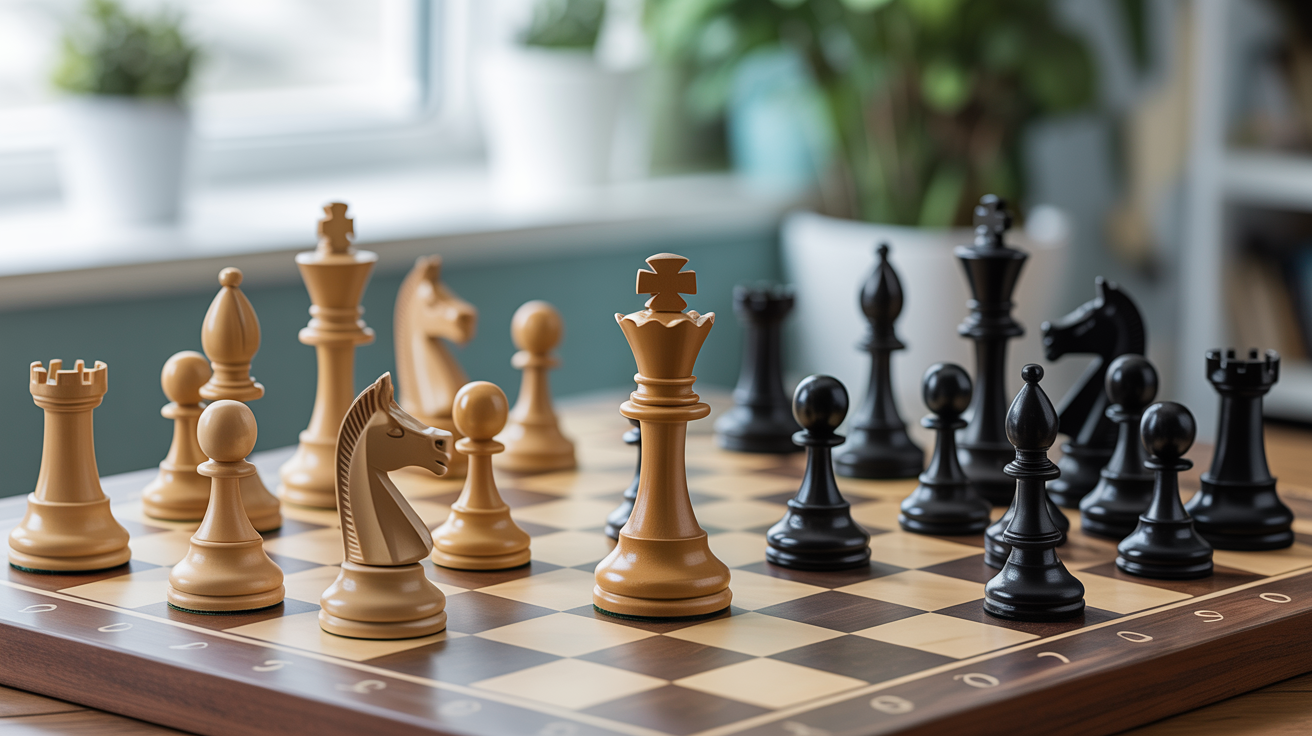
Once you know algebraic notation, chess books, websites, and apps open up completely. You can replay grandmaster games, study puzzles with written solutions, and keep score of your own games. It takes about ten minutes to learn the basics.
What Algebraic Notation Actually Is
Every square on the board has a unique address. Files (columns) are labeled a through h, left to right from White's side. Ranks (rows) are labeled 1 through 8, bottom to top from White's side. So the square in White's bottom-left corner is a1, and the square in White's top-right corner is h8.
A move in algebraic notation names the piece that moved and the square it landed on. That's the whole system.
Here's the board layout as a quick reference:
| Rank | a | b | c | d | e | f | g | h |
|---|---|---|---|---|---|---|---|---|
| 8 | a8 | b8 | c8 | d8 | e8 | f8 | g8 | h8 |
| 7 | a7 | b7 | c7 | d7 | e7 | f7 | g7 | h7 |
| 6 | a6 | b6 | c6 | d6 | e6 | f6 | g6 | h6 |
| 5 | a5 | b5 | c5 | d5 | e5 | f5 | g5 | h5 |
| 4 | a4 | b4 | c4 | d4 | e4 | f4 | g4 | h4 |
| 3 | a3 | b3 | c3 | d3 | e3 | f3 | g3 | h3 |
| 2 | a2 | b2 | c2 | d2 | e2 | f2 | g2 | h2 |
| 1 | a1 | b1 | c1 | d1 | e1 | f1 | g1 | h1 |
The White pieces start on ranks 1 and 2. The Black pieces start on ranks 7 and 8.
The Piece Letters
Each piece has a one-letter abbreviation (in English):
| Piece | Letter |
|---|---|
| King | K |
| Queen | Q |
| Rook | R |
| Bishop | B |
| Knight | N |
| Pawn | (none) |
The Knight is N because K is already taken by the King. Pawns get no letter at all, if you see a bare square like e4, a pawn moved there.
Reading a Move
The format is: [Piece][destination square].
Nf3means "a knight moved to f3."Bc4means "a bishop moved to c4."Qd1means "a queen moved to d1."e4means "a pawn moved to e4" (no piece letter for pawns).
Moves are written in pairs, with White's move first:
1.e4 e5 2.Nf3 Nc6 3.Bc4
Read that as: White plays 1.e4, Black answers 1...e5, White plays 2.Nf3, Black answers 2...Nc6, White plays 3.Bc4. That's the start of the Italian Game.
When you see just Black's move written on its own (in annotations or mid-sentence), it picks up three dots: 3...Nf6. The dots show that White already moved on move 3.
Special Symbols You'll See
A handful of symbols carry specific meaning. You'll spot these constantly in annotated games:
| Symbol | Meaning |
|---|---|
x | Capture (e.g., Nxe5 = knight captures on e5) |
+ | Check |
# | Checkmate |
O-O | Kingside castling |
O-O-O | Queenside castling |
=Q | Pawn promotes to queen (or =R, =B, =N for other pieces) |
! | Good move |
? | Mistake |
!! | Brilliant move |
?? | Blunder |
!? | Interesting move (debatable) |
?! | Dubious move |
A full sequence with some of these: 15.Rxf7+ Kxf7 16.Qxd5+ Ke8 17.Qe6#, rook captures on f7 with check, king takes, queen captures d5 with check, king retreats to e8, queen to e6 checkmate.
When Two Pieces Can Reach the Same Square
Sometimes two identical pieces can both move to the same square. In that case, you add a file letter or rank number to clarify which one moved.
Two rooks, one on a1 and one on h1, can both reach d1. If the one on a1 moves there: Rad1. If the one on h1 moves there: Rhd1.
If two pieces share the same file but different ranks (say, knights on f3 and f6), add the rank: N3e5 vs. N6e5.
How to Write Your Own Moves
Writing notation is easier than it first seems. During a game, just note the piece and where it landed. After a capture, add the x. After check, add +. That covers 95% of games.
A short example game written out properly:
1.e4 e5 2.Nf3 Nc6 3.Bc4 Bc5 4.O-O Nf6 5.d3 d6 6.Bg5 h6 7.Bxf6 Qxf6
Try copying this onto a board and replaying it. You'll see that notation gives you everything you need to reconstruct the position.
Once you can follow a scoresheet, you're ready to study how to get better at chess, recorded games and annotated collections become genuinely useful tools instead of walls of confusing symbols.
Reading Annotations in Chess Books and Apps
Published games include notes that appear in parentheses or after move numbers. A typical annotated line looks like this:
9.Ng5?! (Better was 9.d4 exd4 10.Nxd4 with equality.) 9...d5! 10.exd5 Nd4
The move in parentheses is a variation, an alternative the annotator thinks was stronger. Everything after the closing parenthesis continues the main game. When the variation ends, you return to the move number shown. On any digital board, you can click into variations. In a book, you replay them separately.
Evaluation symbols like = (equal position), +/- (slight advantage for White), or -/+ (slight advantage for Black) sometimes appear at the end of a line. These come from the annotator's assessment, not a fixed rule.
Online platforms and apps display notation in a move list beside the board. Chess.com and Lichess both let you click any move to jump to that position. That makes following along straightforward, much easier than replaying from a book, especially when you're starting out. When you want to try practicing chess tactics with puzzles, the puzzles show notation for every step of the solution so you can check your thinking.
A Short Drill to Lock It In
Set up a board and run through this sequence, writing each move yourself as you go:
- White pawn to e4, Black pawn to c5 (Sicilian Defense)
- White knight to f3, Black knight to d7
- White bishop to c4, Black pawn to e6
- White castles kingside, Black knight to gf6
- White pawn to d3, Black bishop to e7
Your score should read: 1.e4 c5 2.Nf3 Nd7 3.Bc4 e6 4.O-O Ngf6 5.d3 Be7
Note move 4: White's O-O needs no clarification. Black's Ngf6 needs the g because there was already a knight on d7 that could also reach f6, so you specify the knight coming from the g-file.
Once this feels comfortable, try playing through a few short games from where to play chess online for free and read the move list alongside the board. Within a couple of sessions, notation will feel natural.
FAQ
Do I need to memorize all the symbols before I start?
No. The captures (x), check (+), and castling (O-O) are the only ones you'll need to follow most games. The evaluation marks (!, ?, etc.) are annotations and don't change how the position is reconstructed, you can pick them up as you go.
Is algebraic notation the same everywhere?
In English-language chess, yes. Some older books and some European languages use different piece letters (in German, the knight is S for Springer, for example). If you see unfamiliar letters, check the key at the front of the book. The square addresses (a1 through h8) are universal.
What's the difference between long and short algebraic notation?
Short algebraic notation (used in this article) names only the destination square and adds a file or rank letter only when necessary to resolve ambiguity. Long algebraic notation always names both the starting and destination squares, for example, e2e4 instead of e4. You'll see long notation used in computer software and some databases. Both describe the same moves.
How do I write a pawn capture?
Write the file the pawn was on, then x, then the destination square. A pawn on e4 capturing a piece on d5 is written exd5. If that capture results in check, add +: exd5+.
Can I use notation to replay games I find online?
Yes, and this is one of the best reasons to learn it. Copy any PGN game score (most chess sites offer a "Copy PGN" button), paste it into Lichess or Chess.com's analysis board, and it loads instantly. You can step through every move, turn on the computer engine, and explore alternatives. Even a short 20-move game teaches you more when you can replay it move by move with annotations.